Having spent 21 years in Pastoral ministry I have spent the last 18 months working for AIM, the last 6 of which in this new role. As I have begun, I have invested most of that time in talking to church leaders in FIEC (Fellowship of Independent Evangelical Churches) circles about what mission looks like in their churches. These are some of my overall thoughts in response to this initial period of surveying the scene.
Have local churches lost their global mission vision? I want to say, gently but clearly, no. I do not think the heart for the nations has disappeared. But I do think the context in which local churches are trying to be faithful has changed very significantly, and that change can easily be misread.
I am speaking, of course, from my own limited tribe: independent evangelical churches. But from that perspective, the story over the last few decades has not been one of churches abandoning global mission, so much as churches having to think about mission in more directions at once.
When I was younger, the picture felt fairly straightforward. Evangelism was what we did at home, among people who were assumed to share at least some Christian memory or worldview. Mission was what happened overseas, among the nations, and that was largely entrusted to mission agencies. Churches prayed, gave, welcomed missionary speakers, and supported those who went. The mission agency had a very visible place in church life.
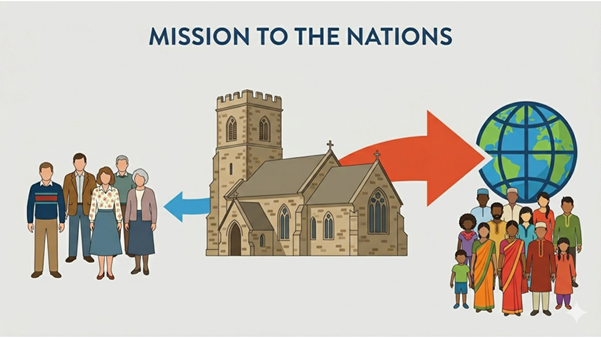
But by the 1990s many of us were realising that our neighbours at home did not share the worldview we had assumed. People on our doorstep often had little real knowledge of the Bible or the gospel, so, churches quite rightly began to speak about mission at home. They employed staff for community outreach, evangelism and training. They thought harder about church planting, unreached estates, and parts of the country where gospel witness had become thin.
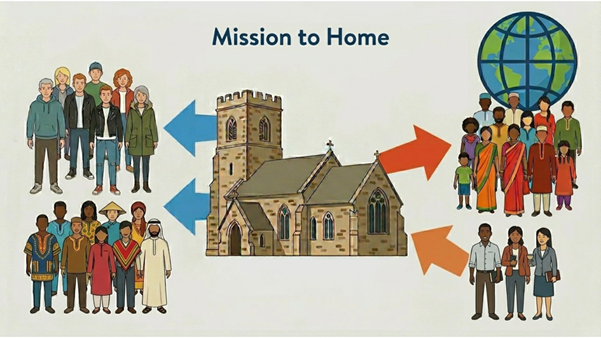
Then another change became obvious: the nations were now at home. Migration meant that Muslim, Hindu, Sikh and other neighbours were no longer simply people we imagined “over there”; they were in our towns, schools and workplaces. Local churches had to learn to cross cultures without crossing oceans. Literature, hospitality, language, worldviews and friendship all needed fresh attention. That did not remove overseas mission, but it did add another layer of faithful responsibility.
More recently still, churches have experienced mission to home. Brothers and sisters from overseas have joined our congregations, bringing great blessing, but also requiring patient work if welcome is to become genuine integration. At the same time, gospel workers from parts of the world once thought of as receiving missionaries are now serving here. They often move in networks many of us do not yet know or understand. Again, this is not a loss of global concern; it is global mission arriving in the local church’s ordinary life.
So, if mission agencies feel that churches are less available, less responsive, or less obviously engaged, I understand why. There are also now fewer meeting points than there used to be. Many churches no longer have central mission prayer meetings or spare Sunday evenings. Pulpits are more tightly guarded. Churches also tend to choose fewer but deeper partnerships, rather than a long list of agencies receiving occasional gifts and deputation visits. That can feel like a closed door to new relationships, even when the partnerships that do exist are richer and healthier.
There has also been an ecclesiological shift. In my circles, churches increasingly want to own mission more directly. They are not simply asking agencies to recruit workers and raise funds; they are asking agencies to partner with them in what the church is seeking to do. That is a good instinct, though we are still learning how to do it well.
At the same time, the word “mission” has widened. It now includes cross-cultural gospel work overseas, gospel work in post-Christian Britain, ministry among diaspora communities, welcoming believers from other nations, and learning from missionaries coming to us. That makes the picture more complicated. It also means that the old flow of church support towards mission agencies can appear smaller, not because the vision has gone, but because the field of vision has expanded.
In contrast to this widening sense of mission from a local church perspective missiologists have been honing in on unreached people groups in less accessible areas and hard to reach frontier regions making global mission more specialist and niche.
What concerns me then is that this has resulted in the development of a mission subculture which can feel disconnected from local church life. Even as someone who grew up around missionaries, served as a pastor, and led churches with mission links, I discovered in this new role with AIM that there was a whole mission world I barely knew. We need to bridge that gap. We also need a stronger UK missions voice: places where church leaders, agency leaders and missiologists can think together about our particular setting.
So have local churches lost their global mission vision? No. But the world has changed, the UK has changed, and the local church’s mission board now reflects a much more complex reality: a handful of deeper partnerships, some overseas and some in the UK; perhaps a compassion agency; perhaps an international café; perhaps workers sent, received and welcomed in several directions. The task now is not to criticise churches for losing a vision they may not have lost, but to serve them in engaging in global mission as part of the heart of local church discipleship in this new and more complex landscape.
If you wish to contact Paul about this topic, please email [email protected]